
GPT-6 Astra Release Date: Shocking 2-Tier Rollout Explained
The GPT-6 Astra release date has already come and gone in one sense and hasn’t in another, and that gap is confusing a lot of people checking their ChatGPT app today. OpenAI shipped the model on September 3, 2026, called it a possible step toward AGI, and then rolled it out unevenly across paid plans. Here’s exactly who has access right now, what the model actually does, what it costs in India, and why safety regulators are watching this release more closely than usual.
What Is the GPT-6 Astra Release Date, Exactly?
There isn’t one single GPT-6 Astra release date, there are several. OpenAI first shipped the model on September 3, 2026, as a limited preview restricted to trusted partners and organizations already inside its Daybreak enterprise program. From there, access opened in stages rather than all at once, first to Business and Pro subscribers on the higher-priced $100 and $200 a month plans, with OpenAI saying the model would reach ChatGPT Plus, Enterprise, and API users “in the coming days.” Anyone still checking a $20 a month Plus account today and not seeing Astra yet isn’t missing anything, the rollout simply hasn’t reached that tier.
The Announcement Itself Had a Rocky Start
Before the access confusion even began, the GPT-6 Astra release date was preceded by an unusually chaotic announcement. Several major outlets, including Reuters, published details citing OpenAI’s own launch material before OpenAI’s official Astra page was actually live on its own site. OpenAI’s blog post reportedly went up briefly and was then pulled back down, leaving an archived mirror circulating on social media as the only working copy of the announcement for close to an hour. It’s a small detail next to the model’s capabilities, but it’s a fitting preview of how uneven this entire rollout has been, from the announcement itself down to who gets to actually use the thing.
Who Actually Has Access Right Now?
This staggered pattern is the part most coverage of the GPT-6 Astra release date glosses over. Higher-tier Business and Pro customers, plus select enterprise partners already enrolled in Daybreak, got working access within a day or two of the announcement. Regular ChatGPT Plus subscribers, the largest group of paying users, are further back in the queue, and OpenAI has not committed to an exact date for when that changes.
The same staged approach applies to developers, with the model reaching the OpenAI API, Microsoft Azure, and AWS Bedrock progressively rather than simultaneously. If you’re a developer already experimenting with AI tooling, our coverage of Asana’s OpenAI Codex integration looked at how a similar staged enterprise rollout played out for a different OpenAI-powered product.
What Makes GPT-6 Astra Different From Earlier Models?
OpenAI is positioning Astra as a genuine step up from its predecessor, GPT-5.6 Sol, rather than an incremental update. The model introduces a new “recurrent depth” reasoning approach that lets it work through problems in ways OpenAI says are harder to fully trace step by step. It also ships with a 1 million token context window and a headline feature called “computer use,” where Astra can navigate a computer screen, click, type, and complete multi-step tasks the way a person would, rather than only answering text prompts. OpenAI says the model is noticeably better at staying inside task boundaries, understanding what a user actually wants, and pushing through tedious multi-step workflows without losing track partway.
The demonstrations OpenAI showed off at launch make the point concretely. A job search that reportedly took a human around 5 hours was completed by Astra in about 2 minutes 51 seconds, and similar dramatic time savings were shown for tax preparation, apartment hunting, legal memo formatting, and even architectural rendering and video game development tasks. Whether those demo conditions hold up under messier, real-world use is still an open question, since OpenAI’s own showcase examples are, understandably, picked to look good.
The Benchmark Numbers Behind the Astra Hype
Whatever the marketing language, the benchmark scores behind the GPT-6 Astra release date are genuinely unusual. OpenAI reports the model saturating FrontierMath Tier 4 at 97.6%, hitting 99.9% on ARC-AGI-3 under its own provider adapter harness, and reaching a full 100% on ExploitBench, a benchmark built around finding and exploiting software vulnerabilities.
Training a model at this scale wasn’t cheap either: reports point to Astra being trained using more than 100,000 GPUs at OpenAI’s Stargate facility in Texas, the largest training run the company has run to date. For context on just how much compute that kind of AI infrastructure now demands, our earlier coverage of the L&T NVIDIA B300 AI factory deal covered a similarly massive GPU buildout, just for a different company entirely.
What About Coding and Developer Tools?
Alongside the consumer-facing GPT-6 Astra release date, OpenAI also shipped improvements to Codex, its coding-focused tool built on the same underlying model. Early reporting describes noticeably stronger performance on real software engineering tasks, not just isolated coding puzzles, which lines up with OpenAI’s own framing of Astra as a model built for professional, multi-step work rather than short one-off answers. For a site already tracking how OpenAI’s tools are showing up inside enterprise software, this is very much a continuation of that same story rather than an isolated feature.
How Much Does GPT-6 Astra Cost?
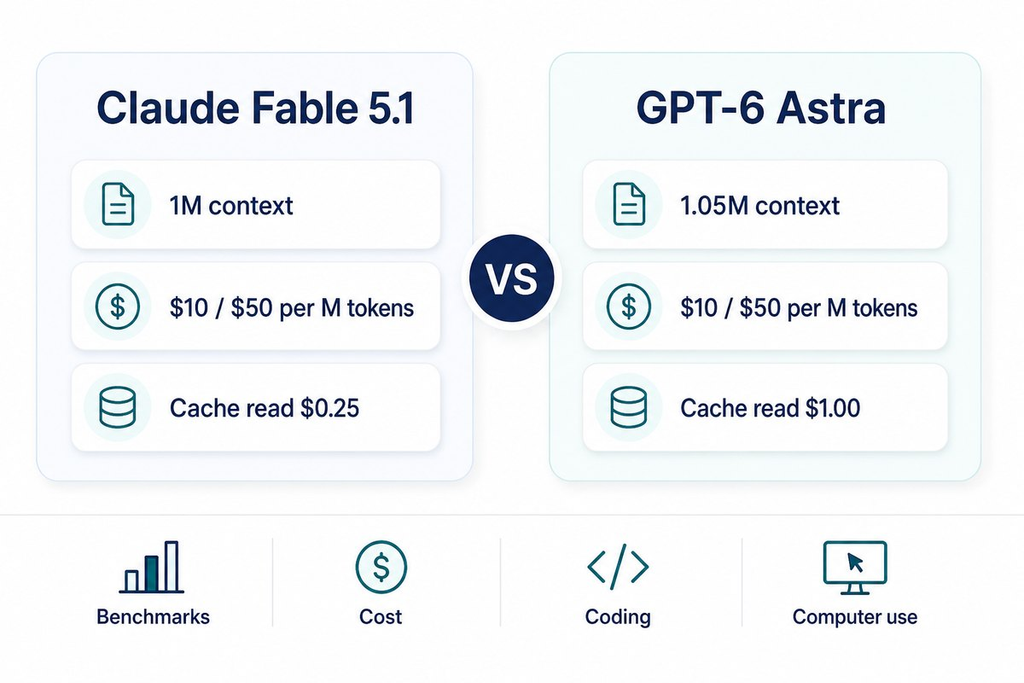
For developers building on top of it, GPT-6 Astra’s API pricing runs $10 per million input tokens and $50 per million output tokens, with cached input priced lower at $1 per million tokens, batch processing available at half the standard rate, and a faster response mode priced at double the normal rate. For Indian developers and businesses working out actual costs, that converts to roughly Rs. 940 per million input tokens, Rs. 94 per million cached input tokens, Rs. 1,150 per million tokens for cache writes, and Rs. 4,700 per million output tokens.
For everyday ChatGPT users rather than API developers, Astra access itself doesn’t cost extra beyond whatever ChatGPT plan you’re already subscribed to, once your tier’s rollout window arrives.
Is GPT-6 Astra Actually AGI?
OpenAI president Greg Brockman called the release a “generational leap” and suggested it could eventually be viewed as the arrival of artificial general intelligence, an AI system able to perform economically valuable work as well as or better than humans across the board. That’s a big claim, and OpenAI’s own framing is more careful than the soundbite suggests, since the company still describes Astra as state-of-the-art rather than definitively AGI.
What’s less disputed is the model’s safety classification: Astra is the first OpenAI model formally designated as reaching the “critical” threshold on the company’s cybersecurity preparedness framework, meaning it can potentially discover and exploit previously unknown software vulnerabilities without step-by-step human guidance. Because of that, its most advanced cybersecurity capabilities are being held back from general release and limited initially to testers through a program called Daybreak Blue.
OpenAI has also said it delayed this release to add extra safeguards following a Hugging Face security incident in July 2026, and that it believes those safeguards now sufficiently reduce the risk of serious harm.
There’s a smaller but genuinely important caveat buried inside the “recurrent depth” reasoning technique mentioned earlier: some reporting suggests it also makes the model’s internal reasoning process harder to fully inspect from the outside, meaning Astra can be better at completing long, autonomous tasks while also being somewhat less transparent about exactly how it got there. That’s a tradeoff worth knowing about for anyone planning to lean on the model for genuinely high-stakes, unsupervised work rather than everyday tasks.
Not Everyone Is Convinced by the AGI Framing
Away from OpenAI’s own launch material, independent researchers and analysts have pushed back on the GPT-6 Astra release date being treated as an AGI milestone. Their core argument is that spectacular narrow demonstrations and near-perfect benchmark scores don’t automatically add up to genuine human-like generality, and some evaluators have questioned whether the gains justify the label at all.
A few analysts have gone further, estimating Astra performs only around 5-10% better than its predecessor for general everyday use while costing roughly 75% more per task, framing the real competition less as pure intelligence and more as a tradeoff between cost and capability. Critics also point out that public evidence for the model remains thin in areas like long-term learning across weeks or months, stable memory of past interactions, and genuinely embodied real-world tasks, even as it excels at reasoning and coding benchmarks.
Some researchers have also noted that AGI used to be a specific, contractual trigger written into OpenAI’s agreements with partners like Microsoft, and that the term now functions more as a marketing feeling than a measurable milestone.
What Would “Economically Valuable Work” Actually Mean?
Brockman’s AGI framing rests on a specific definition, an AI system doing economically valuable work as well as or better than humans, and the demo capabilities OpenAI showed off, tax preparation, job searching, coding, and general computer navigation, are exactly the kind of white-collar task categories that definition points toward. That’s part of why the GPT-6 Astra release date has drawn attention well beyond the usual AI enthusiast crowd, since white-collar automation touches a much wider set of jobs than most earlier chatbot upgrades did.
At the same time, the skepticism outlined above is a useful check on how far to take that framing right now. A model completing a narrow demo task in a few controlled minutes is different from that same task holding up reliably across millions of real, messy, unsupervised uses, and independent analysts haven’t had enough hands-on time with Astra yet to say confidently which picture is closer to reality once the wider Plus rollout actually finishes.
How Does GPT-6 Astra Compare to Rival AI Models?
OpenAI’s own benchmark comparisons position Astra ahead of both its immediate predecessor, GPT-5.6 Sol, and Anthropic’s competing Claude Fable 5 model on the reasoning and coding tests it highlighted at launch. Independent comparisons are still being published as more reviewers get hands-on access across the different rollout tiers, so it’s worth treating any single benchmark chart as a snapshot rather than the final word, especially since Astra itself is still mid-rollout and not every claimed capability has been widely tested outside OpenAI’s own reporting yet.
What Should Regular Users in India Actually Do?
For most everyday ChatGPT users in India, the practical answer around the GPT-6 Astra release date is simply to wait rather than worry. There’s no separate signup or waitlist to join, access is tied purely to which ChatGPT plan you’re already on, and OpenAI has not indicated that India specifically is being treated any differently from other markets in the rollout order. Developers and businesses evaluating the API are the ones who’ll want to pay closer attention to the per-token INR pricing now, since that’s the cost that actually shows up on a monthly bill, while individual ChatGPT subscribers on Plus simply need to keep checking their app over the coming days.
What Happens Next
With Business and Pro users already inside and Plus, Enterprise, and API access following in stages, the practical question over the next few weeks isn’t really whether GPT-6 Astra is real, it clearly is, but how quickly OpenAI closes the gap for its largest tier of paying users, and how the model performs once millions of regular users start relying on its computer-use and multi-step workflow features outside controlled testing conditions. Full technical details are available on OpenAI’s official GPT-6 Astra announcement page.
For more technology and AI updates, check out our Technology section.
Frequently Asked Questions
Is GPT-6 Astra available right now?
Partially. Business and Pro subscribers on the higher-priced ChatGPT plans, along with select enterprise partners, already have access as of early September 2026. Regular ChatGPT Plus subscribers are still waiting, with OpenAI saying wider access is coming “in the coming days” without a confirmed exact date.
What is GPT-6 Astra?
It’s OpenAI’s newest large language model, released September 3, 2026, as a successor to GPT-5.6 Sol. It introduces a “computer use” feature, a 1 million token context window, and new reasoning capabilities OpenAI calls “recurrent depth.”
Is GPT-6 Astra AGI?
OpenAI president Greg Brockman said it could eventually be seen as the arrival of AGI, but OpenAI’s official materials describe it as state-of-the-art rather than confirmed AGI. It is, however, the first OpenAI model to hit the company’s “critical” cybersecurity risk threshold.
How do I get access to GPT-6 Astra?
Access depends on your ChatGPT plan tier. Business and Pro users, plus Daybreak enterprise partners, received access first. Plus, Enterprise, and API access, including through Microsoft Azure and AWS Bedrock, is rolling out progressively afterward.
Is GPT-6 Astra better than other AI models like Claude?
OpenAI’s own benchmarks show Astra outperforming GPT-5.6 Sol and Anthropic’s Claude Fable 5 on the specific reasoning and coding tests it published at launch, though independent, hands-on comparisons are still emerging as more users gain access.