
FCRA Amendment Bill 2026: Official Provisions Cut Jail Term from 5 to 1 Year
The FCRA Amendment Bill 2026 has sparked debate since being introduced in the Lok Sabha, with organizations that receive foreign funding closely watching how the proposed changes could reshape compliance requirements and, in some cases, put their assets at risk.
Here’s a clear, balanced breakdown of what the bill actually proposes, why it was introduced, and the concerns being raised around it.
What Is the FCRA Amendment Bill 2026?
The Foreign Contribution (Regulation) Amendment Bill, 2026, as tracked by PRS India, was introduced in the Lok Sabha on March 25, 2026. It proposes changes to how India regulates organizations that receive foreign contributions, particularly around what happens when an organization’s FCRA registration is cancelled, surrendered, or not renewed.
Under the current law, organizations receiving foreign funds must hold a renewable 5-year FCRA certificate, with an alternate “prior permission” route available for one-time recipients. As of July 2026, there were 14,449 active FCRA certificates in India, alongside 22,498 cancelled and 15,212 expired ones.
Why Was This Bill Introduced?
The stated aim of the FCRA Amendment Bill 2026 is to create a clearer regulatory mechanism for managing the foreign contributions and assets of organizations that lose their FCRA registration, whether through cancellation, voluntary surrender, or simply not renewing it in time.
Key Provisions of the FCRA Amendment Bill
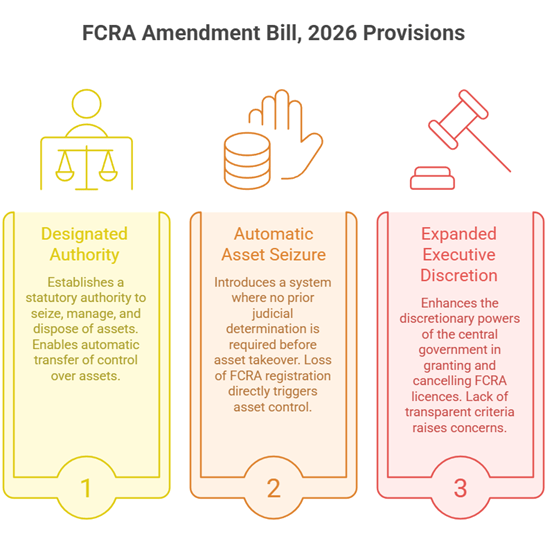
- A new Designated Authority: The bill creates this authority specifically to vest, supervise, manage, and dispose of foreign contributions and assets once an organization’s certificate ceases to be valid.
- Non-renewal now counts too: Previously, asset-related consequences were tied mainly to cancellation or surrender. Under the new bill, simply failing to renew a certificate in time can also trigger the same asset vesting process.
- Mixed-source assets: Even if an asset was only partly funded through foreign contributions, it would vest entirely with the Designated Authority, though organizations can request the return of any clearly identifiable domestically-funded portion.
- Religious sites protected: The Authority is required to maintain the religious character of any places of worship that fall under its management.
Reduced Penalties
One notable change in the FCRA Amendment Bill 2026 works in favor of violators: the maximum imprisonment term for FCRA violations has been reduced from five years to one year.
Concerns Raised About the Bill
Civil society groups and some organizations have raised several concerns about the FCRA Amendment Bill 2026:
- No real exit option: Because non-renewal can trigger asset seizure just like cancellation, organizations effectively cannot stop receiving foreign funds without risking their existing assets, even if they no longer need or want continued foreign funding.
- Minimum spending pressure: Under the related FCRA Rules, 2026, organizations are expected to utilise at least Rs. 10 lakh in foreign contributions over two financial years to be considered active, which critics argue pressures organizations to keep seeking foreign funds rather than reducing dependency on them.
- No appeal for non-renewal: Unlike outright cancellation, a denied renewal currently offers no clear appeal mechanism or hearing before assets could be seized.
- Unequal treatment: Assets held by “prior permission” recipients aren’t subject to the same vesting rules once their permission expires, which critics say creates inconsistency between the two categories of foreign-fund recipients.
A delegation raised these concerns on July 25, 2026, describing the bill in its current form as unacceptable and calling for wider consultation before it is enacted.
Government’s Response
Union Minister Kiren Rijiju has pushed back against what he described as misinformation around the FCRA Amendment Bill 2026, and separately, Mizoram’s Chief Minister said the Home Minister had assured him the bill would not have retrospective effect.
For more updates on Indian policy and legislation, check out our National section, including our recent coverage of the UPI transactions charges clarification.
Frequently Asked Questions
What is the FCRA Amendment Bill 2026?
It’s a proposed law that changes how India manages the assets and foreign contributions of organizations whose FCRA registration is cancelled, surrendered, or not renewed, while also creating a new Designated Authority to oversee this process.
When was the FCRA Amendment Bill 2026 introduced?
It was introduced in the Lok Sabha on March 25, 2026.
Does the FCRA Amendment Bill reduce or increase penalties?
It reduces the maximum imprisonment term for FCRA violations from five years to one year.
What are the main concerns about the FCRA Amendment Bill 2026?
Critics say the bill makes it difficult for organizations to exit the FCRA framework without risking their assets, pressures them to keep seeking foreign funds, and offers no appeal mechanism for denied renewals.
Will the FCRA Amendment Bill apply retrospectively?
According to Mizoram’s Chief Minister, the Union Home Minister assured that the bill would not have retrospective effect, though this has not been addressed in the bill’s text itself as reported.
Pingback: Tribunals Reforms Bill 2026: Official Overhaul Creates 1 National Commission - NovaKhabar