
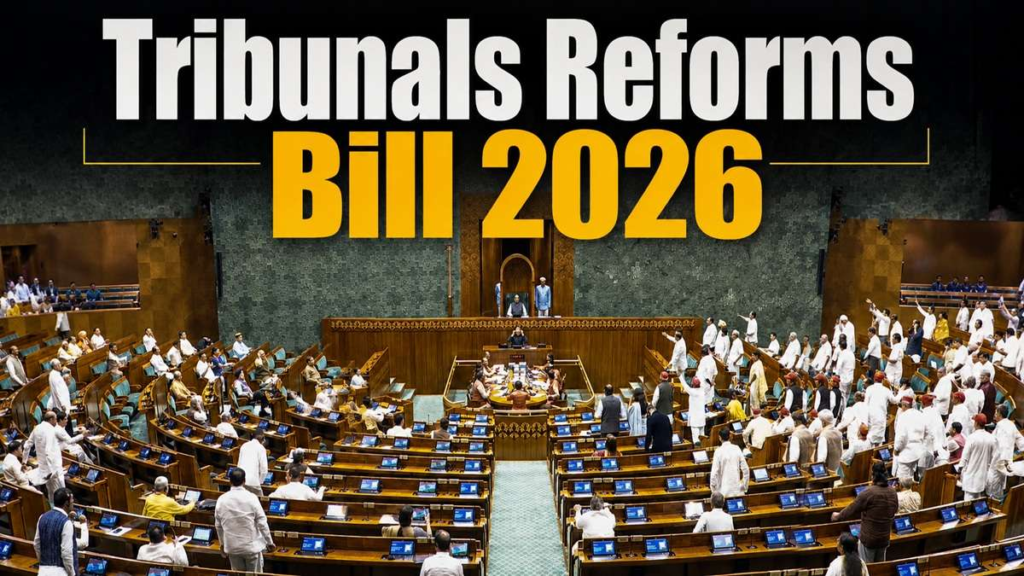
Tribunals Reforms Bill 2026: Official Overhaul Creates 1 National Commission
The Tribunals Reforms Bill 2026 has officially cleared Parliament, marking one of the most significant overhauls to India’s tribunal system in years. Here’s a complete breakdown of what the bill does, why it was needed, and what changes for the tribunals that affect millions of pending cases.
What Is the Tribunals Reforms Bill 2026?
The Tribunals Reforms Bill 2026, as tracked by PRS India, was introduced in the Lok Sabha on August 10, 2026, and passed by the Rajya Sabha the very next day, on August 11, 2026, officially clearing both houses of Parliament. The Lok Sabha passage notably happened without debate, amid Opposition protests over an unrelated issue, after Law Minister Arjun Ram Meghwal introduced the bill.
The legislation seeks to repeal the earlier Tribunals Reforms Act, 2021, and replace it with a more structured, uniform framework governing how tribunals across India are staffed and run.
Why Was This Bill Needed?
According to reports, the Supreme Court itself had identified serious inefficiency and a lack of independence within India’s tribunal system. Chronic vacancies, unusually short tenures, restrictive age criteria, and excessive executive control over appointments had all raised concerns about whether tribunals could function with genuine judicial independence, rather than being subject to shifting executive influence.
The National Tribunals Commission
The centerpiece of the Tribunals Reforms Bill 2026 is the creation of a new National Tribunals Commission (NTC), headquartered in New Delhi. The NTC is designed to function as an independent institutional mechanism responsible for:
- Conducting selection processes for tribunal vacancies
- Reviewing the performance of existing tribunals
- Managing a digital repository of case-related information
- Overseeing inquiries into complaints against tribunal officials
The Commission itself will be composed of a chairperson (a former Supreme Court judge or High Court chief justice), two judicial members (former chief justices or judges of a High Court), and two technical members with at least 25 years of experience across fields like public administration, finance, law, accountancy, banking, or technology.
National Tribunals Data Grid
Alongside the NTC, the Tribunals Reforms Bill 2026 also introduces a National Tribunals Data Grid, a comprehensive digital repository of case-related information for tribunals such as the Income Tax Appellate Tribunal and the National Green Tribunal, intended to improve transparency and make performance monitoring far easier than under the previous system.
Appointment Process and Tenure Changes
Under the new framework, Search-cum-Selection Committees, made up of retired judges and senior government secretaries, will recommend candidates for tribunal positions. Crucially, the Central government will now be required to make appointments within three months, directly addressing the chronic vacancy delays that plagued the previous system.
Tenure has also been standardized:
- Chairpersons: Five years, or until age 70, whichever comes first
- Members: Five years, or until age 67, whichever comes first
This replaces a patchwork of shorter, inconsistent terms that varied across different tribunals.
How Many Tribunals Are There in India?
India currently has around 16 tribunals, covering areas ranging from tax and administrative disputes to environmental and company law matters. The Tribunals Reforms Bill 2026 aims to bring uniformity across this entire ecosystem, rather than continuing with tribunal-specific rules that varied widely in practice.
Who Appoints the CAT Chairman Now?
The Central Administrative Tribunal (CAT), like other tribunals covered under this reform, will now have its chairperson selected through the NTC’s Search-cum-Selection Committee process, with the Central government required to finalize the appointment within three months of a vacancy arising, rather than through the more executive-driven process used previously.

Criticism of the Bill
Not everyone welcomed the reform without reservation. Congress MP Jairam Ramesh pointed out that the government had “stoutly resisted” similar tribunal reforms in the past, suggesting it was ultimately “compelled” to bring in these changes rather than doing so purely on its own initiative, an argument that frames the bill as a response to sustained judicial and public pressure rather than a proactive reform.
For more updates on Indian policy and legislation, check out our National section.
You can also read about the FCRA Amendment Bill 2026 for more recent legislative coverage.
And check out our piece on UPI transactions charges for more government policy clarifications.
Frequently Asked Questions
What is the Tribunals Reforms Bill 2026?
It’s a law passed by both houses of Parliament in August 2026 that overhauls India’s tribunal system by creating a National Tribunals Commission to oversee appointments, performance, and case data across tribunals.
How many tribunals are there in India?
India currently has around 16 tribunals, covering areas such as tax, administrative, environmental, and company law disputes.
Who appoints the CAT chairman?
Under the new law, the Central Administrative Tribunal’s chairperson is selected through the National Tribunals Commission’s Search-cum-Selection Committee, with the Central government required to finalize the appointment within three months.
What are tribunal reforms?
Tribunal reforms refer to structural changes aimed at improving the independence, efficiency, and consistency of tribunals, addressing issues like chronic vacancies, short tenures, and excessive executive control over appointments.
When did the Tribunals Reforms Bill 2026 pass Parliament?
The Lok Sabha passed it on August 10, 2026, and the Rajya Sabha passed it the following day, on August 11, 2026.

The Tribunals Reforms Bill 2026 is a significant step toward creating a more efficient, transparent, and independent tribunal system in India. The proposed National Tribunals Commission and uniform appointment and tenure framework could help address long-standing issues such as vacancies and inconsistent administration. However, effective implementation and maintaining judicial independence will be crucial for these reforms to achieve their intended impact.
Pingback: DMK Attends Speaker Tea Party: Official Split as 3 INDIA Bloc Allies Boycott - NovaKhabar