

Delhi Master Plan 2047: Official Gazette Notification Brings 40 Lakh Homes
The Delhi Master Plan 2047 has moved from draft to official policy, the Union government issued its Gazette notification on August 20, 2026, and the Delhi Development Authority is now holding public consultations to turn it into real projects.
Key Takeaways:
- The Delhi Master Plan 2047 received its Gazette notification on August 20, 2026, making it official policy, not just a draft.
- The plan targets 30-40 lakh new homes for 3.2 crore people by 2047, up from the 20 lakh figure in the original August 12 draft.
- Delhi’s metro network will expand from 416 km to 695 km, with six new RRTS corridors also planned.
- A September 2026 policy change cut the minimum redevelopment area from 40,000 to 3,000 square metres, potentially unlocking 7 lakh more homes.
- Roughly 180 square kilometres of the Yamuna floodplain and Ridge will be protected even as construction expands elsewhere.
What Is the Delhi Master Plan 2047?
The Delhi Master Plan 2047 is the statutory land-use and development document that will govern how the National Capital Territory grows over the next two decades, covering zoning, housing, transport, infrastructure, and environmental safeguards.
It replaces the earlier Master Plan for Delhi-2041 and aligns with the central government’s broader Viksit Bharat 2047 vision. Union Housing and Urban Affairs Minister Manohar Lal Khattar described it as a framework meant to accelerate urban development while protecting Delhi’s environmentally sensitive areas, a balance the plan tries to strike through zone-specific rules rather than blanket restrictions or blanket permissions.
Timeline: From Draft to Gazette Notification
The Delhi Master Plan 2047 moved through three distinct stages in just over a month, each adding more detail and larger numbers than the one before it.
The Delhi Development Authority first approved a draft version on August 12, 2026, which proposed 20 lakh new flats and redevelopment of nearly 4 lakh ageing DDA-built flats. On August 20, the plan was formally unveiled with sharply expanded numbers, 30-40 lakh new homes and a 695-km metro target, and received its official Gazette notification the same day under Section 11-A of the Delhi Development Act, 1957, with Lieutenant Governor Taranjit Singh Sandhu’s approval at a DDA meeting. Through September 2026, the DDA has been running a wider consultation process, around 20 planned sessions over three months with developers, planners, landowners, and government bodies, to convert the plan’s broad targets into actual projects and policies.
Housing: Up to 40 Lakh New Homes
Housing is the single biggest number in the Delhi Master Plan 2047, and it has grown significantly as the plan moved from draft to final policy.
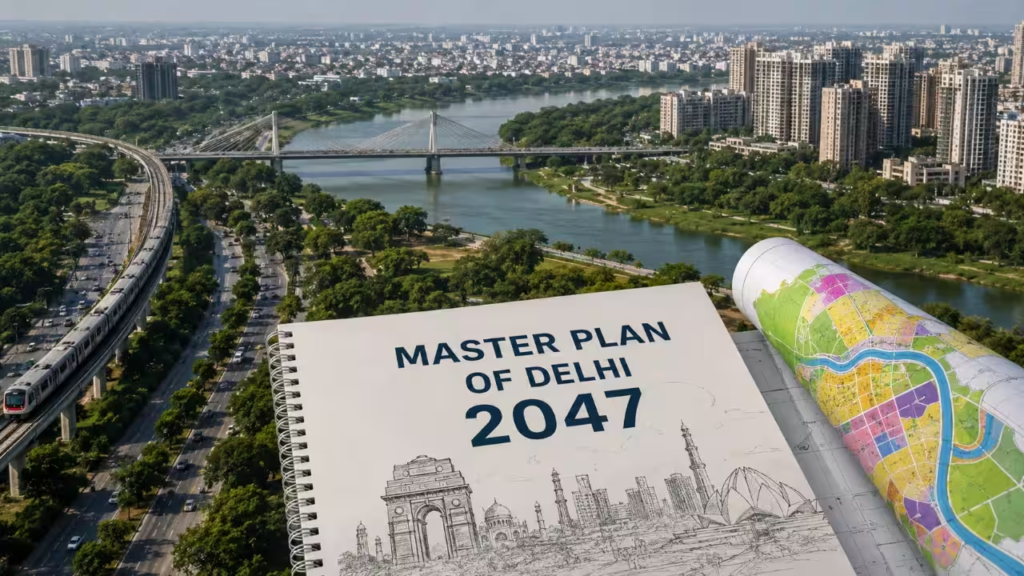
The original August 12 draft approved 20 lakh new flats plus redevelopment of nearly 4 lakh DDA-built flats over 50 years old. The fully unveiled version raised this to a combined 30-40 lakh new homes for a projected population of 3.2 crore people by 2047, with a strong focus on affordable housing. A September 2026 policy change added further capacity on top of that, reducing the minimum area required to redevelop existing group housing, DDA, and government housing from 40,000 square metres to just 3,000 square metres, a change officials estimate could unlock around 7 lakh additional dwelling units by making many more existing housing societies eligible for redevelopment.
Metro and RRTS Expansion
Delhi’s metro network, currently around 416 kilometres, is set to expand to 695 kilometres under the Master Plan 2047, alongside six new Regional Rapid Transit System corridors.
This marks a major jump from the single RRTS line currently operational connecting Delhi to neighbouring cities. The plan also introduces a Transit Oriented Development policy encouraging affordable housing construction around planned transit hubs, and permits high-rise construction within a 250-metre radius of Urban Extension Road-2 (UER-2), which runs from Alipur through Rohini, Najafgarh, and Dwarka to Mahipalpur. A land-use change has also been cleared for a new metro depot serving the Rithala-Kundli corridor.
Village Development and Green Development Areas
Delhi’s peripheral villages see some of the most specific changes under the Master Plan 2047, with different villages getting different treatment depending on their location and existing land use.
Around 105 villages will be developed through land pooling arrangements, while roughly 70 villages, including Tikri Kalan, Mitraon Dhansa, Mehrauli, Chhatarpur, and Satbari, will instead be designated as Green Development Areas with restrictions aimed at limiting dense construction in those zones.
Yamuna Floodplain and Environmental Protections
Despite the scale of new construction being planned elsewhere, the Delhi Master Plan 2047 splits the 22-kilometre Yamuna floodplain stretch into two distinct zones with different rules.
The O-1 zone, covering the high-risk area that floods roughly once every 25 years, keeps construction fully prohibited. The O-2 zone, outside that high-risk band, permits regulated recreational uses like parks. Combined with Ridge protections, the government says roughly 180 square kilometres of floodplain and Ridge area will be protected under the new framework, positioning environmental safeguards as a parallel priority alongside the growth targets.
Regularisation and the September 2026 Redevelopment Update
Beyond new construction, the Master Plan 2047 also addresses Delhi’s large stock of unauthorised and ageing housing through two separate measures confirmed as the plan moved into its implementation phase.
The plan provides for regularisation of residential buildings in 1,511 unauthorised colonies on an “as is where is” basis, giving residents of those colonies a clearer legal status without requiring demolition or relocation. Separately, the reduced 3,000 square metre minimum redevelopment threshold specifically targets Delhi’s many ageing group housing societies and DDA colonies that were previously too small to qualify for redevelopment under the old 40,000 square metre rule. Our coverage of the Indian Railways PPP station redevelopment programme looks at a comparable push to modernise decades-old public infrastructure at the national level.
Air Taxis, Air Pods, and an Inland Waterway System
Among the more futuristic elements of the Master Plan 2047 are air taxis and air pods intended to ease road traffic congestion, along with a proposed inland waterway transport system running along the Yamuna River.

Both ideas remain conceptual for now, without a confirmed implementation timeline, cost estimate, or regulatory framework, and officials have described them as long-term aspirations within the plan rather than near-term commitments. The plan also introduces a single-window clearance system meant to cut down the time and number of departments involved in project approvals, which officials say is necessary to deliver on the plan’s much larger numbers within the 2047 timeframe.
What Happens Next
With the Gazette notification complete and implementation consultations underway through September 2026, the Delhi Master Plan 2047 is now a binding legal framework rather than a draft proposal, though actually delivering on its numbers will take years.
The DDA’s roughly 20 planned consultation sessions over three months are expected to produce more detail on funding mechanisms, land pooling arrangements, and phased timelines, none of which happens quickly for a plan covering 30-40 lakh homes and a nearly 300-kilometre metro expansion. For more national infrastructure and policy updates, check out our National section.
Frequently Asked Questions
Has the Delhi Master Plan 2047 been legally notified yet?
Yes, it received its Gazette notification on August 20, 2026, under Section 11-A of the Delhi Development Act, 1957, making it official policy rather than a draft.
How many new homes does the Delhi Master Plan 2047 ultimately propose?
The headline target is 30-40 lakh new homes for a projected population of 3.2 crore people by 2047, with a September 2026 policy change potentially unlocking roughly 7 lakh more homes through easier redevelopment rules.
What happens to unauthorised colonies under this plan?
Residential buildings in 1,511 unauthorised colonies are provided for regularisation on an “as is where is” basis under the plan.
Which villages are designated as Green Development Areas?
Roughly 70 peripheral villages, including Tikri Kalan, Mitraon Dhansa, Mehrauli, Chhatarpur, and Satbari, are designated as Green Development Areas with construction restrictions.
Does the Delhi Master Plan 2047 include air taxis?
Yes, air taxis and air pods have been proposed to ease traffic congestion, along with an inland waterway system on the Yamuna, though both remain conceptual without a confirmed timeline.

Pingback: Master Plan 2047 Delhi: Amazing 695km Metro, 40 Lakh Homes Unveiled - NovaKhabar