
New COVID Variant PJ 2.1: Official WHO Status Fact Check
The new COVID variant PJ 2.1 has spread to multiple countries since first being detected in May 2026, but despite some media coverage framing it as a confirmed global threat, it does not currently appear on WHO’s global variant tracking list at all.
What Is the New COVID Variant PJ 2.1?
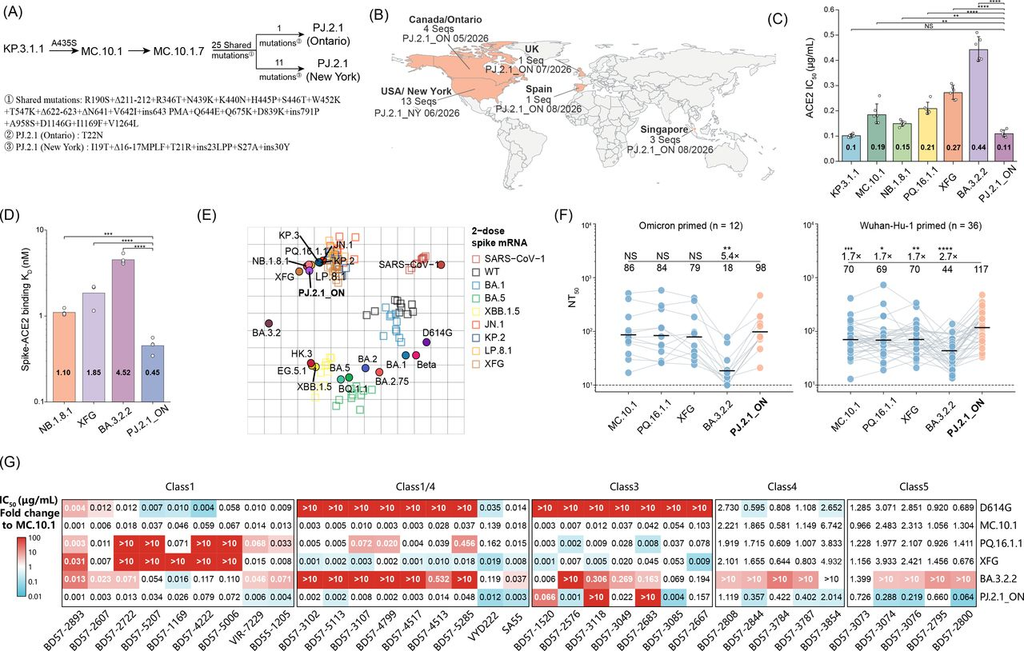
PJ 2.1, formally written in scientific lineage notation as PJ.2.1, is a highly mutated descendant of an earlier lineage called MC.10.1, first detected in May 2026, with its earliest known samples tracing back to Ontario, Canada.
Since then, it has been detected at multiple sites across the United States and, more recently, in the United Kingdom, Singapore, and Spain, showing clear geographic spread even though its overall share of global COVID cases remains low according to independent virologist analysis of the available sequencing data.
Has WHO Officially Classified the New COVID Variant PJ 2.1?
No, as of this writing, PJ 2.1 does not appear anywhere on the World Health Organization’s global variant tracking page, not as a Variant Under Monitoring, a Variant of Interest, or a Variant of Concern.
According to WHO’s own tracking page, last updated July 28, 2026, the currently listed Variants Under Monitoring are PQ.16.1.1, NB.1.8.1, XFG, and BA.3.2, a separate variant covered in our earlier reporting. The statements about PJ 2.1 circulating in media, including a warning about rising spread risk, have come specifically from WHO’s Russia regional office rather than a formal global WHO classification, an important distinction that several headlines have blurred together.
What Do Early Studies Say About PJ 2.1’s Mutations?
A scientific preprint, meaning it hasn’t yet completed formal peer review, reports that PJ 2.1 binds the human ACE2 receptor considerably better than recent circulating strains, despite carrying more than 25 spike protein mutations.
Importantly, the same research found that despite this large number of mutations, PJ 2.1 remains antigenically similar to the circulating JN.1 family of variants and does not show strong evidence of evading existing immunity built up through vaccination or prior infection. This combination, notable binding changes without strong immune escape, is part of why virologists studying it have described its ultimate trajectory as genuinely uncertain rather than alarming.
Scientists describe this kind of mutation pattern, sometimes called a saltational jump, as a large, sudden cluster of genetic changes rather than the slow, gradual accumulation typically seen in most circulating lineages. Earlier saltation variants have shown unpredictable real-world trajectories, some spread widely while others faded without ever becoming dominant, which is exactly why researchers are being cautious about predicting what happens next with this particular variant.
Is the New COVID Variant PJ 2.1 More Dangerous Than Others?
There is currently no published clinical data showing that PJ 2.1 causes more severe illness than other recently circulating SARS-CoV-2 variants, a point WHO’s Russia office itself explicitly stated even while flagging rising spread risk.
Russian virologist Albert Rizvanov has separately said PJ 2.1 is unlikely to become the dominant strain in Russia, noting that many variants which initially worried scientists never ended up spreading widely or causing a meaningfully different disease pattern. This kind of early, geographically-limited uncertainty is actually fairly typical for newly flagged variants, most don’t go on to replace whatever variant is currently dominant.
This doesn’t mean the new COVID variant PJ 2.1 should be dismissed entirely, continued genomic surveillance is exactly how earlier variants that did eventually matter were first identified, it simply means the current evidence doesn’t yet support treating it as a confirmed higher-severity threat.
Is the Claim About PJ 2.1 Causing Deaths in China True?
No, this specific claim should be treated as unverified and likely false, it traces back to a single September 2026 article citing an anonymous virologist, with no corroboration from any of the scientific or public health sources covering this variant.
No legitimate health authority, including WHO’s own regional offices actively discussing PJ 2.1’s spread risk, has linked this variant to a surge in severe cases or deaths anywhere, in China or otherwise. This is a useful reminder that during any period of uncertainty around a new, genuinely spreading variant, unverified claims citing anonymous sources tend to circulate faster than the actual, more measured scientific assessment, so it’s worth checking a claim’s origin before sharing it further.
If a health claim about a specific variant cites only an unnamed source and isn’t echoed by any national health ministry, WHO office, or peer-reviewed research, that’s a strong signal to treat it with skepticism until a named, verifiable source confirms it independently. For more health and science coverage, including our look at the separately-tracked BA.3.2 variant, check out our earlier COVID variant report.
Frequently Asked Questions
Is PJ 2.1 the same variant as BA.3.2?
No, these are two separate, distinct variants currently being discussed, BA.3.2 is an officially WHO-listed Variant Under Monitoring, while PJ 2.1 is a newer, more recently detected variant not yet on WHO’s global tracking list.
Does having 25 or more spike mutations automatically make PJ 2.1 dangerous?
Not necessarily, despite its high mutation count, early research found it remains antigenically similar to the circulating JN.1 family and doesn’t show strong evidence of evading existing immunity.
Which countries have confirmed PJ 2.1 cases so far?
It was first detected in Canada and has since been found in the United States, United Kingdom, Singapore, and Spain, though its overall global case share remains low.
How can I protect myself while scientists study this new COVID variant?
Standard precautions still apply, staying current on recommended vaccines, practicing good hygiene, and testing when you have symptoms, since these measures remain effective regardless of which specific variant, PJ 2.1 included, happens to be circulating in your area.
