
Why Do Pilots Say Brace? The Shocking Truth Behind 70% Survival Odds
Why do pilots say brace? The short answer is that “brace” is the command that tells everyone on board to get into a specific position designed to reduce injury in the seconds before an impact, and despite a persistent internet myth, it has nothing to do with dental records. Here’s exactly what the position involves, whether it actually works, and the answers to everything else people search alongside this question, from seat 11A to why pilots say “Mayday.”
Why Do Pilots Say Brace?
Why do pilots say brace comes down to one specific goal: giving passengers a physical position that’s been studied and shown to reduce injury and death in the final seconds before impact. The command isn’t a formality or a scare tactic, it’s tied directly to aviation safety research going back decades, and crews are trained to give it with enough time for passengers to actually get into position when a crash landing or emergency is anticipated in advance.
It’s worth separating this from a crash that happens with no warning at all, where there’s no time to brace regardless. The command specifically applies to situations like an emergency landing, a ditching in water, or any scenario where the crew has advance notice that impact is coming, which is most aviation accidents, not the sudden mid-air catastrophes that dominate headlines and disaster movies.
What Does the Brace Position Actually Involve?
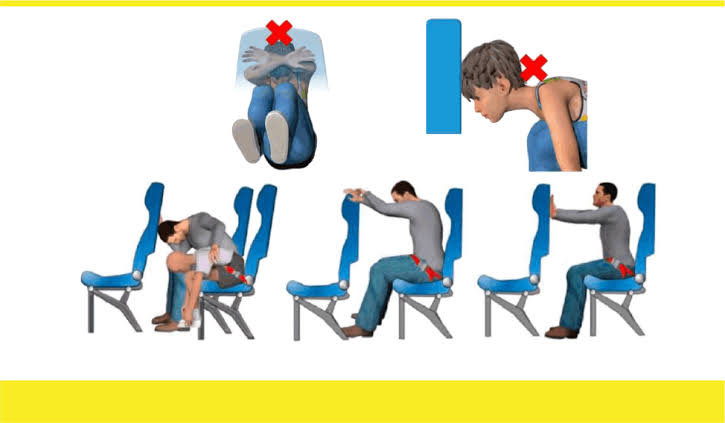
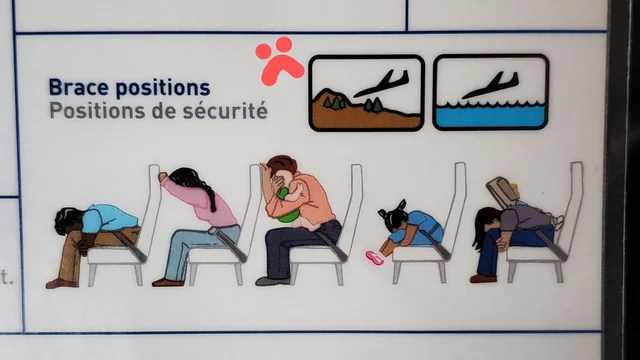
According to the FAA’s own cabin safety guidance, US passengers in forward-facing seats are told to place their hands on top of the seat in front of them, one hand holding the opposite wrist, and rest their head in the space between their arms. If the seat ahead is out of reach, the alternative is to grab your ankles or place your hands under your legs and hold the opposite forearm. Feet should stay flat on the floor, tucked as far back under the knees as possible to reduce shin injuries.
Notably, the FAA specifically does not recommend placing your hands behind your neck, since its own research found that position adds unnecessary strain during impact.
Is the Brace Position on a Plane Actually Safe?
Yes. The brace position is backed by decades of aviation safety research and has two clear, tested purposes: reducing flailing and reducing secondary impact, meaning it pre-positions your body, especially your head, against whatever surface it would otherwise strike during a crash.
Does the Brace Position Actually Work?
The data says yes, clearly. The US National Transportation Safety Board’s review of accidents between 1983 and 1999 found that more than 95% of aircraft occupants survived overall, and 55% survived even in the most severe crashes. Australia’s Civil Aviation Safety Authority separately found that over 70% of airline accidents are survivable, and that 71% of deaths in survivable crashes happen after the aircraft has already come to a stop, largely because people weren’t properly braced or prepared.
The Debunked Myth Behind the Brace Position
A long-running internet myth claims the real reason pilots and flight attendants ask you to brace has nothing to do with survival, that it’s actually there to preserve your teeth and jaw so your body can be identified by dental records later, effectively implying airlines don’t expect you to live. This claim has been tested on MythBusters, fact-checked as false by Snopes, and debunked by outlets including Smithsonian Magazine. There is no truth to any version of it. The brace position exists because it measurably improves survival odds, not because airlines have quietly given up on you.
It’s a useful reminder of how easily a piece of aviation folklore can outlive the facts. Once you understand why do pilots say brace in the way safety researchers actually intended it, dental records or not, the instruction reads a lot less ominously.
What Is the Safest Position to Be in a Plane Crash?
The brace position itself is the safest position to be in, correctly executed, since it’s the single factor most directly within a passenger’s own control during impact. Seat location plays a secondary role: a widely cited Popular Mechanics analysis of crashes going back to 1971 found that passengers seated toward the back of the aircraft generally had better survival odds than those near the front, though aviation safety experts are clear that no seat is universally “safest” once you account for how differently each crash unfolds.
Why Avoid Seat 11A on a Plane?
You probably don’t need to avoid it, despite its reputation. Seat 11A became internet-famous after two sole survivors of separate plane crashes, 27 years apart, happened to be sitting there: Ruangsak Loychusak, who survived a 1998 Thai Airways crash, and Ramesh Viswashkumar, the sole survivor of the 2025 Air India Flight AI-171 disaster. In the Air India case, seat 11A happened to sit near an emergency exit on that aircraft’s specific Boeing 787-8 configuration, which can genuinely improve evacuation odds in a survivable, non-instantaneous crash.
Aviation safety experts caution against reading too much into the coincidence. As Flight Safety Foundation director Mitchell Fox has put it, each accident is different, and predicting survivability from seat location alone isn’t reliable, since exit rows and cabin layouts vary by aircraft type. Seat 11A isn’t a lucky charm, it just happened to be an exit-adjacent seat in two specific, very different aircraft.
Why Do Flight Attendants Sit on Their Hands During Takeoff and Landing?
Flight attendants use their own version of the brace position during takeoff and landing, the two phases of flight considered the highest-risk, and sitting on their hands serves a practical purpose: it protects their hands from injury so they remain fully usable for helping passengers with oxygen masks, life vests, or an evacuation if something goes wrong. While seated this way, many flight attendants also perform a “silent review,” mentally rehearsing emergency procedures, door operations, and equipment locations. US airlines aren’t uniformly required to use this exact posture, some crews instead rest hands on their knees or fold their arms, but the underlying safety logic is the same across all the variations.
A Real US Example: The Miracle on the Hudson
The clearest real-world case of the brace position working exactly as intended happened over American skies. On January 15, 2009, Captain Chesley “Sully” Sullenberger ditched US Airways Flight 1549 into New York’s Hudson River after a bird strike knocked out both engines shortly after takeoff. Sullenberger’s calm “brace for impact” announcement gave flight attendants time to get all 150 passengers into position before the water landing, and every single person on board, all 155 passengers and crew, survived. It remains one of the most cited examples anywhere of why do pilots say brace matters in practice, not just in theory.
Why Do Pilots Say “Mayday” When They’re Crashing?
This one’s a different command entirely from brace, but it shows up in the same searches for a reason: both are aviation emergency terms most people only half-understand. “Mayday” comes from the French phrase “m’aider,” roughly “help me,” and was coined in the 1920s by radio operator Frederick Stanley Mockford at Croydon Airport in London. Mockford needed a distress term that pilots could say clearly over voice radio, since ships had “SOS” for Morse code, but “SOS” spoken aloud could be misheard for other letters. Saying “Mayday” three times in a row is now the internationally recognized verbal distress call across aviation.
For official guidance straight from the source, the FAA’s own bulletin on brace-for-impact positions covers the position in full technical detail.
For more explainers like this, check out our Travel section.
How do you brace in a plane crash?
Place your hands on the seat in front of you, one hand holding the opposite wrist, and rest your head between your arms, with feet flat on the floor tucked under your knees. If the seat ahead is unreachable, hold your ankles or grip your opposite forearm under your legs instead.
What is the brace position for flight attendants specifically?
Flight attendants typically sit with their hands under their thighs during takeoff and landing, protecting their hands while performing a silent mental review of emergency procedures, though the exact posture varies slightly by airline.
Is seat 11A actually the safest seat on a plane?
Not reliably. It coincidentally belonged to two crash survivors from unrelated incidents, but experts say survivability depends on the specific aircraft and crash, not a universally lucky seat number.
Why do you do the brace position if most crashes aren’t survivable anyway?
Because most aviation accidents actually are survivable, over 70% according to Australia’s Civil Aviation Safety Authority, and the brace position specifically targets the secondary injuries that cause many deaths even after a survivable impact.