

Japan Cyber Attack Wave: Official State of Emergency 2026
The Japan cyber attack wave of 2026 has grown serious enough that the country’s cybersecurity chief publicly declared a “state of emergency in cyber space,” after a ransomware incident and a string of major data breaches exposed tens of millions of records.
What Is Japan’s “Cyber Emergency” Declaration About?
According to Recorded Future’s reporting, Japan’s cybersecurity chief Masaaki Taira declared a state of emergency in cyberspace on October 9, 2026, following months of escalating incidents.
It’s worth being precise about what this actually means, this is a political and administrative warning meant to signal the severity of the situation and push urgency across government and industry, not a formal legal state of emergency with the kind of binding powers that term might otherwise imply. The declaration followed the Financial Times reporting that more than 20 major Japanese companies had disclosed cyberattacks in recent weeks alone, a disclosure pace that by itself illustrates how widespread the underlying problem had become before officials chose to speak publicly in such stark terms.
What Happened in the IDC Frontier Ransomware Attack?
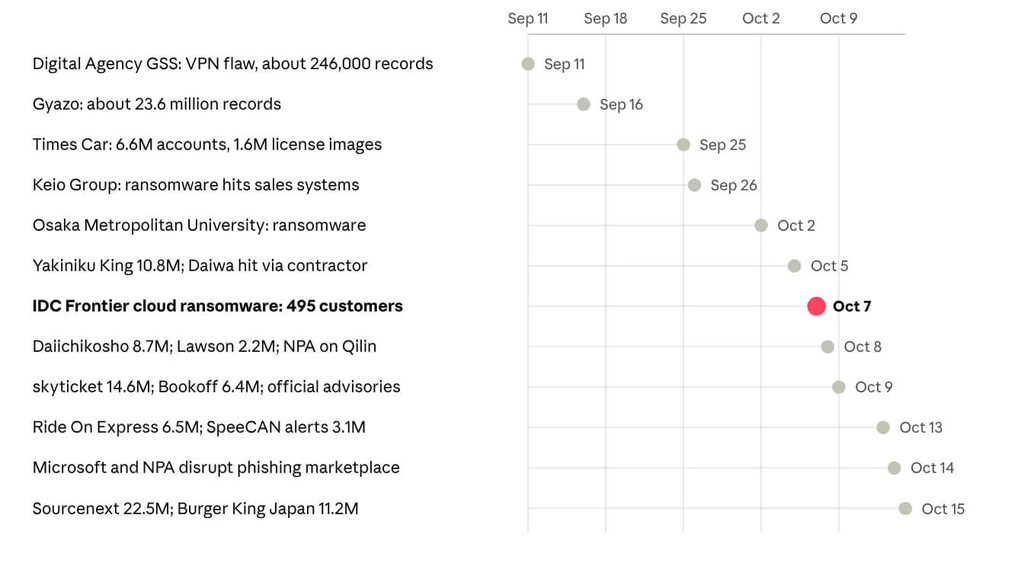
The single biggest disruption in this Japan cyber attack wave was a ransomware incident that hit IDC Frontier, a SoftBank-owned cloud provider, at around 3:40 AM on October 7, 2026.
The attack on IDC Frontier’s cloud infrastructure reached roughly 495 companies and local government bodies that relied on its services, taking Ibaraki Prefecture’s websites offline and disrupting operations at a rail operator and a police headquarters that depended on the affected systems. As of the available reporting, no hacking group has claimed responsibility, and IDC Frontier was still investigating the full scope of the breach.
Which Other Companies Were Hit by This Japan Cyber Attack Wave?
Beyond the IDC Frontier incident, several major Japanese companies across very different industries disclosed serious breaches throughout 2026, showing just how broadly this wave has spread.
Insurer Aflac Japan disclosed a breach affecting 4.38 million policyholders in July, the same month frozen food company Nichirei disconnected its own systems to contain an attack and reservation platform EPARK PeakManager leaked roughly 33 million records. Telecom giant KDDI reported a breach affecting 12 million people, rail operator JR East lost 1.67 million customer email addresses, Times Car disclosed 6.6 million affected accounts in September, and logistics firm Kintetsu World Express also suffered a disruptive ransomware intrusion. Beverage maker Sapporo Holdings additionally reported a cyberattack affecting two of its overseas subsidiaries.
How Big Is This Japan Cyber Attack Wave by the Numbers?
The statistics behind this Japan cyber attack wave are genuinely striking, one survey counted 485 information leaks from cyberattacks by October 13, 2026 alone, already surpassing the 432 recorded across the entirety of 2025.
Recorded Future separately found that incident reports jumped 48%, from 621 to 918, between the second and third quarters of 2026, while Trend Micro reported that the January-to-September 2026 total already exceeded all of 2025 combined. Japan’s National Police Agency logged a record 123 ransomware cases in just the first half of 2026, the highest half-year figure since it began tracking this data in 2020. Media estimates put the total number of exposed citizens above 14 million, though no single official government breakdown of that combined figure has been published.
Is AI Making This Japan Cyber Attack Wave Worse?
Japan’s internal affairs minister specifically cited AI-related risks when urging local governments to strengthen their cybersecurity in August 2026, reflecting genuine official concern about artificial intelligence lowering the bar for attackers.
That said, security experts examining the actual 2026 incidents have said there is no firm evidence that AI directly guided these specific attacks, an important distinction between a reasonable general concern about the technology’s future misuse and what has actually been confirmed about this particular wave of breaches so far. This gap between official rhetoric and confirmed technical findings is worth keeping in mind, since it’s genuinely common for new, headline-grabbing technology to get blamed in early coverage of a crisis before investigators have actually traced the specific tools or techniques attackers used.
How Is Japan’s Government Responding to This Cyber Attack Wave?
Beyond the emergency declaration itself, Japan made a significant policy shift by authorizing its Self-Defense Force to conduct offensive cyber operations starting October 1, 2026, a notable departure from the country’s traditionally defense-only security posture. The timing, just days before the cyber emergency declaration and the IDC Frontier attack, places this policy shift directly alongside the most intense period of this entire Japan cyber attack wave.
Separately, Japan’s National Police Agency has previously linked more than 200 attacks between 2019 and 2024 to the China-linked hacking group MirrorFace, targeting national security and technology data, though that specific espionage campaign is a distinct, older story from the broad ransomware and data-breach wave driving this year’s emergency declaration. Keeping these two threads apart matters for anyone trying to understand the actual Japan cyber attack picture, since state-linked espionage and opportunistic ransomware crime call for very different kinds of defensive and diplomatic responses. For more technology and cybersecurity coverage, check out our Technology section.
Frequently Asked Questions
Has any group claimed responsibility for the IDC Frontier ransomware attack?
No, as of the available reporting, no hacking group has publicly claimed responsibility for the October 7, 2026 attack on IDC Frontier’s cloud infrastructure.
How many people have been affected by Japan’s 2026 data breaches combined?
Media estimates put the total above 14 million exposed citizens, though no single official government figure consolidating all the separate breaches has been published.
What does Japan’s new offensive cyber operations policy actually mean?
Starting October 1, 2026, Japan’s Self-Defense Force is authorized to conduct offensive cyber operations, moving beyond the country’s historically defense-only cybersecurity approach.
Is the Chinese hacking group MirrorFace responsible for this cyberattack wave?
No, MirrorFace’s documented activity covers a separate espionage campaign from 2019 to 2024 targeting national security and tech data, distinct from the 2026 ransomware and data-breach wave behind the emergency declaration.
